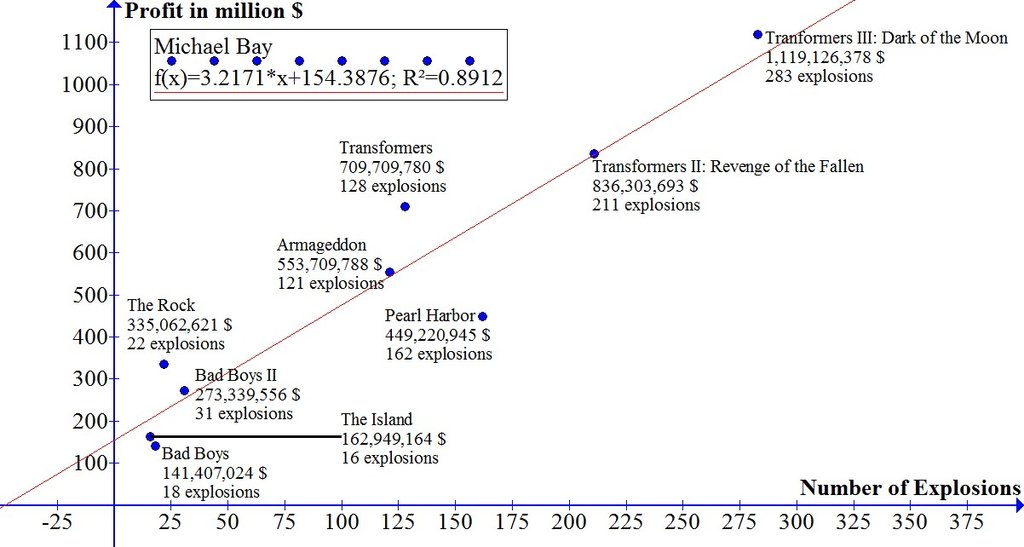
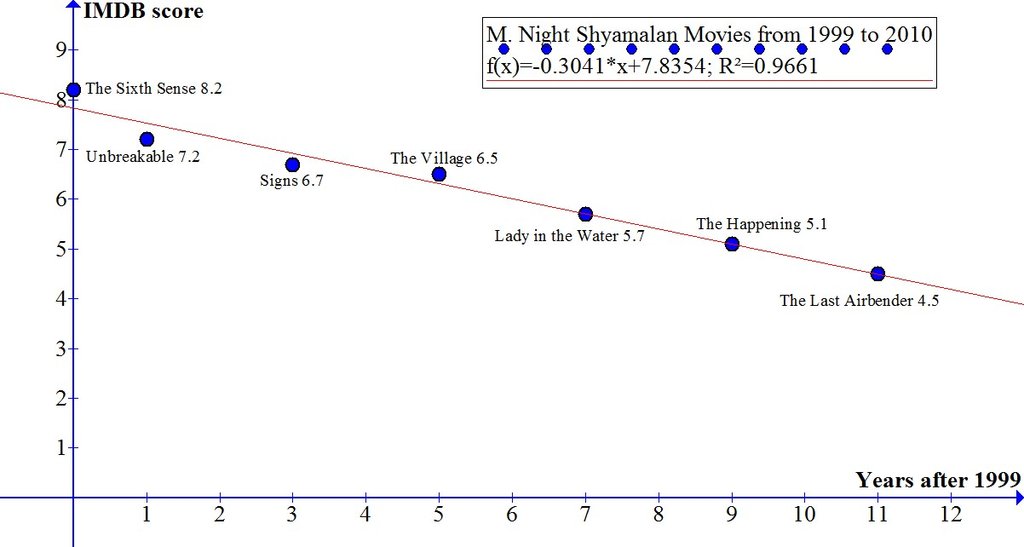
Entries Categorized as 'Algebra'
March 27, 2012
The Correlated website asks people different, apparently unrelated questions every day and mines the data for unexpected patterns.
In general, 72 percent of people are fans of the serial comma. But among those who prefer Tau as the circle constant over Pi, 90 percent are fans of the serial comma.
– ᔥ Correlated.org: March 23′s Correlation.
Two sets of data are said to be correlated when there is a relationship between them: the height of a fall is correlated to the number of bones broken; the temperature of the water is correlated to the amount of time the beaker sits on the hot plate (see here).

A positive correlation between the time (x-axis) and the temperature (y-axis).
In fact, if we can come up with a line that matches the trend, we can figure out how good the trend is.
The first thing to try is usually a straight line, using a linear regression, which is pretty easy to do with Excel. I put the data from the graph above into Excel (melting-snow-experiment.xls) and plotted a linear regression for only the highlighted data points that seem to follow a nice, linear trend.

Correlation between temperature (y) and time (x) for the highlighted (red) data points.
You’ll notice on the top right corner of the graph two things: the equation of the line and the R2, regression coefficient, that tells how good the correlation is.
The equation of the line is:
which can be used to predict the temperature where the data-points are missing (y is the temperature and x is the time).
You’ll observe that the slope of the line is about 4.5 ºC/min. I had my students draw trendlines by hand, and they came up with slopes between 4.35 and 5, depending on the data points they used.
The regression coefficient tells how well your data line up. The better they line up the better the correlation. A perfect match, with all points on the line, will have a regression coefficient value of 1.0. Our regression coefficient is 0.9939, which is pretty good.
If we introduce a little random error to all the data points, we’d reduce the regression coefficient like this (where R2 is now 0.831):

Adding in some random error causes the data to scatter more, making for a worse correlation. The black dots are the original data, while the red dots include some random error.
The correlation trend lines don’t just have to go up. Some things are negatively correlated — when one goes up the other goes down — such as the relationship between the number of hours spent watching TV and students’ grades.

The negative correlation between grades and TV watching. Image: ᔥ Lanthier (2002).
Correlation versus Causation
However, just because two things are correlated does not mean that one causes the other.
A jar of water on a hot-plate will see its temperature rise with time because heat is transferred (via conduction) from the hot-plate to the water.
On the other hand, while it might seem reasonable that more TV might take time away from studying, resulting in poorer grades, it might be that students who score poorly are demoralized and so spend more time watching TV; what causes what is unclear — these two things might not be related at all.
Which brings us back to the Correlated.org website. They’re collecting a lot of seemingly random data and just trying to see what things match up.
Curiously, many scientists do this all the time — typically using a technique called multiple regression. Understandably, others are more than a little skeptical. The key problem is that people too easily leap from seeing a correlation to assuming that one thing causes the other.
Citing this post: Urbano, L., 2012. Curious Correlations, Retrieved May 19th, 2012, from Montessori Muddle: http://MontessoriMuddle.org/ .
Attribution (Curator's Code ): Via: ᔥ Montessori Muddle; Hat tip: ↬ Montessori Muddle.
Posted in Algebra, Mathematics, Natural WorldNo Comments » - Tags: algebra, correlation, excel, heat, math, physics, scientific methods, statistics
March 18, 2012

Venus (brighter) and Jupiter.
Jupiter and Venus have been sitting near the western horizon, shining so brightly that even I have noticed them. Phil Plait explains with some back-of-the-envelope math, why Venus is brighter even though it’s smaller than Jupiter. It’s a nice example of how a little math can do a great job explaining how the world (and others) works.
Citing this post: Urbano, L., 2012. Jupiter and Venus in Conjuction, Retrieved May 19th, 2012, from Montessori Muddle: http://MontessoriMuddle.org/ .
Attribution (Curator's Code ): Via: ᔥ Montessori Muddle; Hat tip: ↬ Montessori Muddle.
Posted in Algebra, Mathematics, Natural WorldNo Comments » - Tags: astronomy, geometry, math applications
March 7, 2012
So that my students could more easily check their answers graphically, I put together a page with a
more complete analysis of parabolas (click
this link for more details).
Analyzing Parabolas
Solution by Factoring:
y = x2 x
Converting the forms
The key relationships are the ones to convert from the
standard form of the parabolic equation:
| |
 |
(1) |
to the
vertex form:
| |
 |
(2) |
If you multiply out the vertex equation form you get:
| |
y = a x2 - 2ah x + ah2 + k |
(3) |
When you compare this equation to the standard form of the equation (Equation 1), if you look at the coefficients and the constants, you can see that:
To convert from the vertex to the standard form use:
Going the other way,
To convert from the standard to the vertex form of parabolic equations use:
Although it is sometimes convenient to let k not depend on coefficients from its own equation:
| |
|
(10) |
The Vertex and the Axis
The nice thing about the vertex form of the equation of the parabola is that if you want the find the coordinates of the vertex of the parabola, they're right there in the equation.
Specifically, the
vertex is located at the point:
| |
|
(11) |
The axis of the parabola is the vertical line going through the vertex, so:
The equation for the axis of a parabola is:
| |
|
(12) |
Focus and Directrix
Finally, it's important to note that
the distance (d) from the vertex of the parabola to its focus is given by:
| |
|
(13) |
Which you can just add
d on to the coordinates of the vertex (Equation 11) to get the
location of the focus.
| |
|
(14) |
The directrix is just the opposite, vertical distance away, so the
equation for the directrix is the equation of the horizontal line at:
| |
|
(15) |
References
There are already some excellent parabola references out there including:
Citing this post: Urbano, L., 2012. Everything You (N)ever Wanted to Know About Parabolas, Retrieved May 19th, 2012, from Montessori Muddle: http://MontessoriMuddle.org/ .
Attribution (Curator's Code ): Via: ᔥ Montessori Muddle; Hat tip: ↬ Montessori Muddle.
Posted in Algebra, Mathematics, Technology, Useful websitesNo Comments » - Tags: algebra, graphs, html5, interactive posts, interactive websites, math
February 26, 2012
Here's a prototype for showing how the
equation of a straight line changes as you change its slope (
m) and intercept (
b):
It starts with an
horizontal line along the x-axis, where the slope is zero and the intercept is zero:
The line moves upward, but stays horizontal, until the intercept is 1.0:
The slope increases from horizontal (m = 0), gradually, until the slope is 0.5:
Finally, we move the line upwards again, without changing the slope (m = 0.5), until the intercept is equal to 4.0:

Now I just need to figure out how to make them interactive.
Citing this post: Urbano, L., 2012. Straight Lines, Retrieved May 19th, 2012, from Montessori Muddle: http://MontessoriMuddle.org/ .
Attribution (Curator's Code ): Via: ᔥ Montessori Muddle; Hat tip: ↬ Montessori Muddle.
Posted in Algebra, MathematicsNo Comments » - Tags: algebra, graphing, html5
February 5, 2012

FOILing.
Multiplying out two factors can be a little tricky. The FOIL mnemonic is a quick method when you have two terms in each factor, such as in:
(a + b)(a + b)
FOIL stands for:
- Firsts,
- Outer,
- Inner,
- Lasts.
It applies to the multiplication of the
binomial cube.

Multiplying out factors using FOIL.
Another way of showing the process -- step by step -- would be like this:

Multiplying factors using FOIL.
After FOILing you combine the similar terms:

Combining like terms to get the final result.
Citing this post: Urbano, L., 2012. FOIL: Multiplying Factors, Retrieved May 19th, 2012, from Montessori Muddle: http://MontessoriMuddle.org/ .
Attribution (Curator's Code ): Via: ᔥ Montessori Muddle; Hat tip: ↬ Montessori Muddle.
Posted in Algebra, MathematicsNo Comments » - Tags: algebra, math, mnemonics
February 2, 2012

Figuring out (a+b)3; with a binomial cube.
After working with the hundred-squares, ten-bars, and thousand-cubes to figure out how to
add polynomials, we borrowed the binomial and trinomial cubes to practice multiplying out factors. It's a physical way of showing
factor multiplication.
Binomial Square
You can first look at the binomial cube in two-dimensions as a binomial square by just finding the area of the top layer of four blocks.
If you label the length of the side of the red block,
a, and the length of the blue block,
b, you can calculate the areas of the individual pieces simply by multiplying their lengths times their widths.

Looking from the top down, the top layer of the binomial cube is a binomial square.
Adding up the individual areas you get the area of the entire square:
However, there is another way.
If you recognize that the length of each side of the entire square is equal to
(a+b).

The length of each side of the cube is the sum of the lengths of the two squares.
Then the total area is going to be total length
(a+b) times the total width
(a+b):
We can multiply this out (using
FOIL is easiest):
which simplifies to give the same result as adding up the individual areas:
The Binomial Cube
We can do the same thing using the entire cube by recognizing that the volume of the cube is the length times width times the depth, and all of these dimensions are the same:
(a+b).

Using the full binomial cube.
Now the students can go through the same process of multiplying out the factors, and can check their work be seeing if they get the same number of pieces (and dimensions) as the physical cube.

Success!
Citing this post: Urbano, L., 2012. Using the Binomial Cube in Algebra, Retrieved May 19th, 2012, from Montessori Muddle: http://MontessoriMuddle.org/ .
Attribution (Curator's Code ): Via: ᔥ Montessori Muddle; Hat tip: ↬ Montessori Muddle.
Posted in Algebra, MathematicsNo Comments » - Tags: algebra, factors, manipulatives, polynomials
January 30, 2012

Working with the thousand cube, hundred square, ten bar and unit cells in algebra.
I sent a couple of my algebra students down to the pre-Kindergarten classroom to burrow one of their Montessori works. They were having a little trouble adding polynomials, and the use of manipulatives really helped.
The basic idea is that when you add something like:

you can't add a
n3 term to a
n2 or a
n term. You only combine the terms with the same degree (and same variables). So the equation above becomes:

which simplifies to:

The kids actually enjoyed the chance to run downstairs to burrow the materials from their old pre-K teacher (and weren't they quite good about returning the materials when they were done with them).
And it clarifies a lot of misconceptions when you can clearly see that that you just can't add a thousand cube to a ten bar -- it just doesn't work.
Citing this post: Urbano, L., 2012. Polynomials: Revisiting pre-Kindergarten , Retrieved May 19th, 2012, from Montessori Muddle: http://MontessoriMuddle.org/ .
Attribution (Curator's Code ): Via: ᔥ Montessori Muddle; Hat tip: ↬ Montessori Muddle.
Posted in Algebra, MathematicsNo Comments » - Tags: algebra, manipulatives, math, Montessori Works
January 28, 2012
We're talking about light and sound waves in physics at the moment, and NPR's Morning Edition just had a great article on how the enormous, ultra-precise, mirrors that are used in large telescopes are made.
Astronomical observatories tend to use mirrors instead of lenses in their telescopes, largely because if you make lenses too big they tend to sag in the middle, while you can support a mirror all across the back, and because you have to make a lens perfect all the way through for it to work correctly, but only have to make one perfect surface for a parabolic mirror.
ScienceClarified has a great summary of the history of the Hubble Space telescope, that includes all the trouble NASA went through trying to fix it when they realized it was not quite perfect.

Large parabolic mirrors are used for magnification in telescopes. (Image via Wikipedia).
In addition, it's interesting to note that you can also make a parabolic surface on a liquid by spinning it, resulting in
liquid telescope mirrors .
Citing this post: Urbano, L., 2012. Parabolic Mirrors, Retrieved May 19th, 2012, from Montessori Muddle: http://MontessoriMuddle.org/ .
Attribution (Curator's Code ): Via: ᔥ Montessori Muddle; Hat tip: ↬ Montessori Muddle.
Posted in Algebra, Natural World, PhysicsNo Comments » - Tags: algebra, light, physics, waves