Entries Categorized as 'student run business'
July 8, 2011
The measure of a man is what he does with power. — attributed to Plato
It’s quite fascinating how character traits are highlighted when students gain the rights and responsibilities of the student run business supervisor. Certainly, some students become a bit over-enthusiastic about exercising their rights; though that’s never been much of a problem for the main supervisor because I try to make sure that anyone who gets to be the main supervisor has spent some time supervising a division. Also, Montessori students get a lot of practice working in their small groups, so leadership positions are usually not too much of a shock to them. Those that do try to throw their weight around excessively, provide the class with the opportunity to discuss worker rights, and a deepening of their understanding of the needs for checks and balances.
What I find most interesting, however, are the students who see only the responsibility of leadership and get bogged down and stressed out trying to manage all the details. For them the practice of leadership does a lot to help build character.
Citing this post: Urbano, L., 2011. Quote for the Day: On Power, Retrieved May 19th, 2012, from Montessori Muddle: http://MontessoriMuddle.org/ .
Attribution (Curator's Code ): Via: ᔥ Montessori Muddle; Hat tip: ↬ Montessori Muddle.
Posted in Classroom Notes, student run businessNo Comments » - Tags: notes, SRB
June 22, 2011

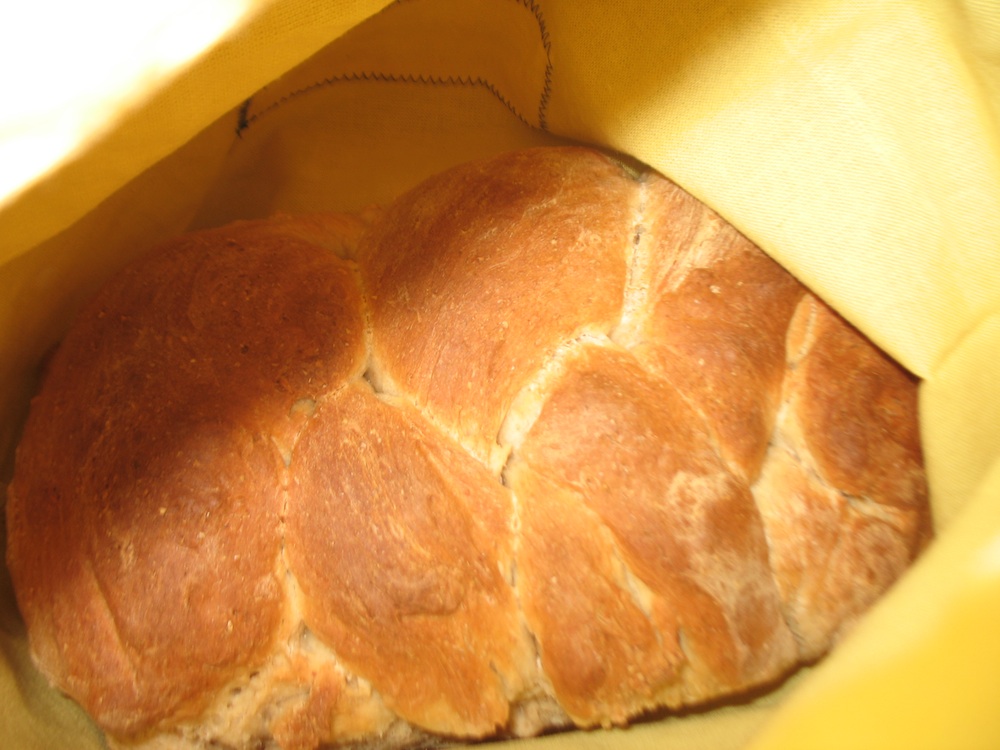
A beautiful loaf, nested in a hand-made bread bag.
Our bread-baking enterprise was quite popular last year. In the afternoons, just as the loaves were about to come out of the ovens, we’d get the occasional visitor poking their head into our room for “aromatherapy”.

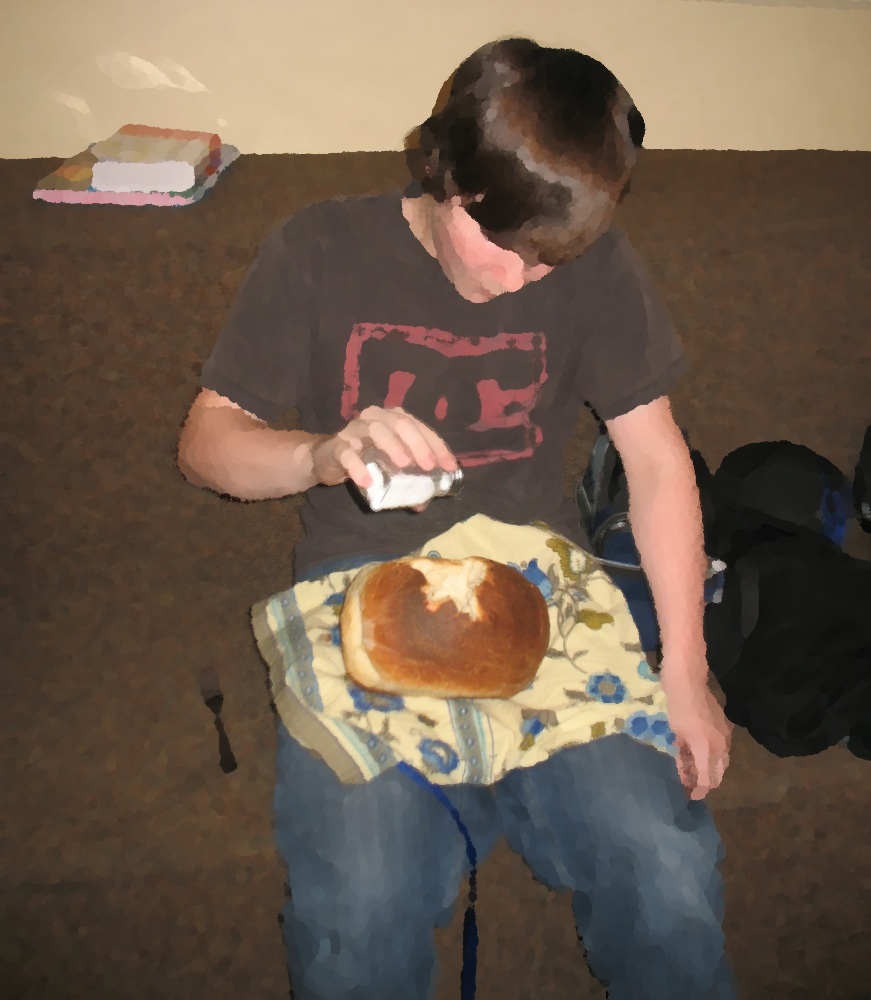
Consumption in progress.
Students also liked the freshly baked bread. Some favored the crust while others liked the insides; which worked out quite nicely most of the time, but I did on occasion come across the forlorn shell of crust, and once, a naked loaf with the crust all gone.
I liked the bread baking for the ancillary reasons: the biology of yeast; the data collection and analysis for the business; having to graph and problem solve with the oven calibration; the chemistry of cooking; and even the chance to study geographic features (primarily lakes and islands, but also dams and erosion).
Equipment
We’d made loaves two at a time. They were big loaves, and that was as much as the students could comfortably kneed.

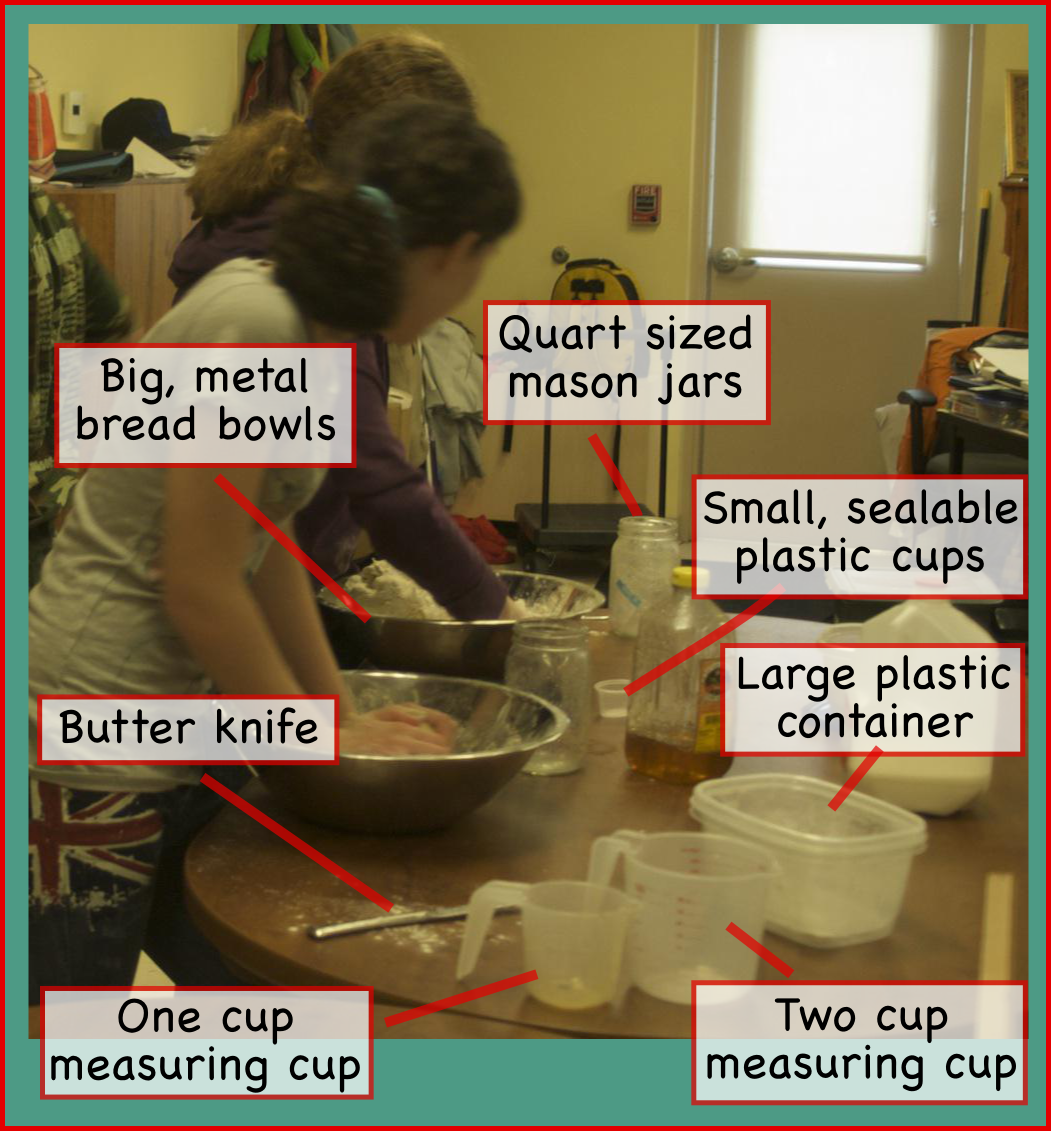
Equipment for making bread.
Small equipment:
- Big mixing bowls: For mixing and kneeding the bread. We used metal ones from the restaurant supply store.
- Quart sized mason jars: For collecting all the liquid ingredients (honey, milk, water and butter). These can go in the microwave (take the metal lids off) to quickly melt the butter and warm the liquids for the yeast.
- Bread load pans: I prefer glass because, with metal the bottoms tend to burn in our toaster ovens. We can fit two pans per oven.
- Two cup measuring cup: For measuring milk and water.
- One cup measuring cup: For measuring honey. There probably is an easier way of doing this but we have not come up with it yet.
- Dry measuring cup: One cup size.
- Measuring spoons: You’ll need the tablespoon, teaspoon and half-teaspoon.
- Butter knife: For cutting butter.
- Small, sealable, plastic cups (optional): For collecting and storing enough yeast (4.5 teaspoons) for one batch of bread.
- Large plastic containers (optional): For storing dry ingredients (flour and salt). They need to be big enough to hold seven cups of flour.
Capital Equipment:
- Microwave oven: Necessary for quickly warming the liquids (for the yeast to make the dough rise).
- Oven: We used table-top, toaster ovens. If the loaves rose well, they’d get too large and get burned by the top of the oven. We probably could reduce the recipe to prevent this. The ovens were not always reliable, and we had to do a regular calibration to make sure the set temperatures were accurate.
Recipe
The simple ingredients can be bought in bulk. This recipe makes two loaves.
Making the Dough
Dry ingredients: These can be combined ahead of time and stored in a large plastic container. When you’re ready to make the bread just dump them into a large mixing bowl.
- Bread flour: 7 cups
- Salt: 4 teaspoons
Wet ingredients: Combine these in a mason jar. They can be kept in the refrigerator for about a week.
- Honey: 6 tablespoons.
- Butter: 4 tablespoons.
- Milk: 2 cups

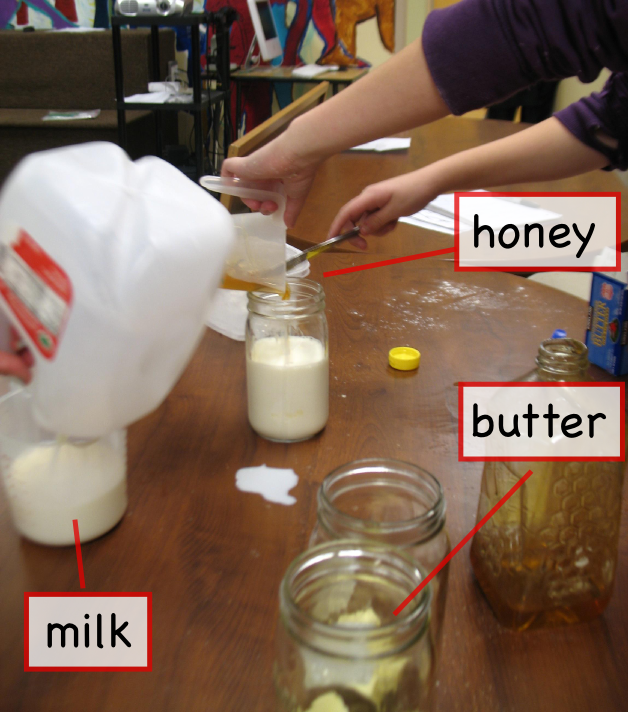
Students put together the wet ingredients in the mason jars. The butter is sliced into smaller pieces and put in first (lower right), then the milk is added (left) and finally the honey (middle).
Microwave: Usually, we microwave the mason jar for about two minutes, which melts the butter nicely but gets the jar a little warmer than is good for the yeast. This is usually a good time to talk about density and stratification, because the honey sits at the bottom, the milk above it, and the butter floating at the top.
Cooling it down: So to make the yeast happy, we usually add some cold (tap) water to the mason jar with the other wet ingredients.
- Water: two thirds (2/3) of a cup (cold from the tap).
Once everything is well mixed and the liquid mixture in the mason jar is at or just above body temperature, add the yeast.
- Yeast: 4.5 teaspoons (which is equivalent to two of the small packets you buy from the store).
- Yeast is much, much cheaper if you buy it in bulk. Even the small, 4 ounce jars at the supermarket are around $4, while a 1 pound bag is about $7. We get ours from Sam’s Club, and store the yeast we have not used yet in a mason jar in the refrigerator.
Stir the yeast in well. Don’t stress if there are still some small clumps.
Combine wet and dry: Dump the contents of the mason jar into the large mixing bowl with the dry ingredients. Do it quickly, otherwise the yeast will settle to the bottom of the jar and not all come out.

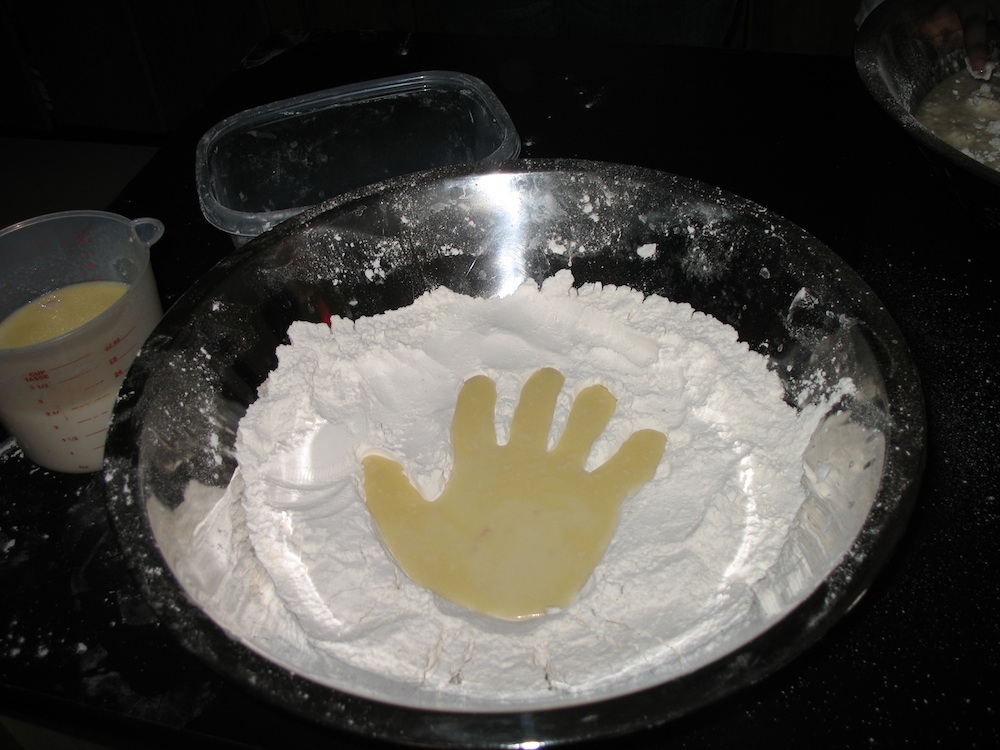
A hand shaped lake in a land of flour.
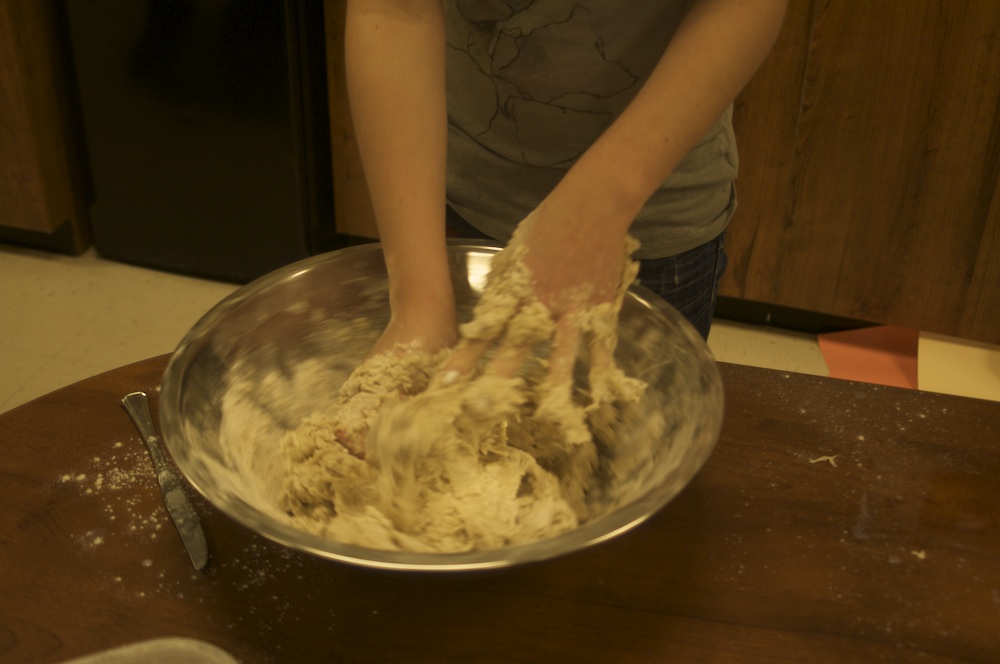
Now, kneed the dough. We usually use our hands and kneed in the mixing bowls. You may need to add a little more flour as you’re kneeding it if the dough is too sticky. Alternatively, you can add a bit of water if it’s too dry, but I’ve found it much easier to start with the dough too wet and add flour than doing it the other way around.
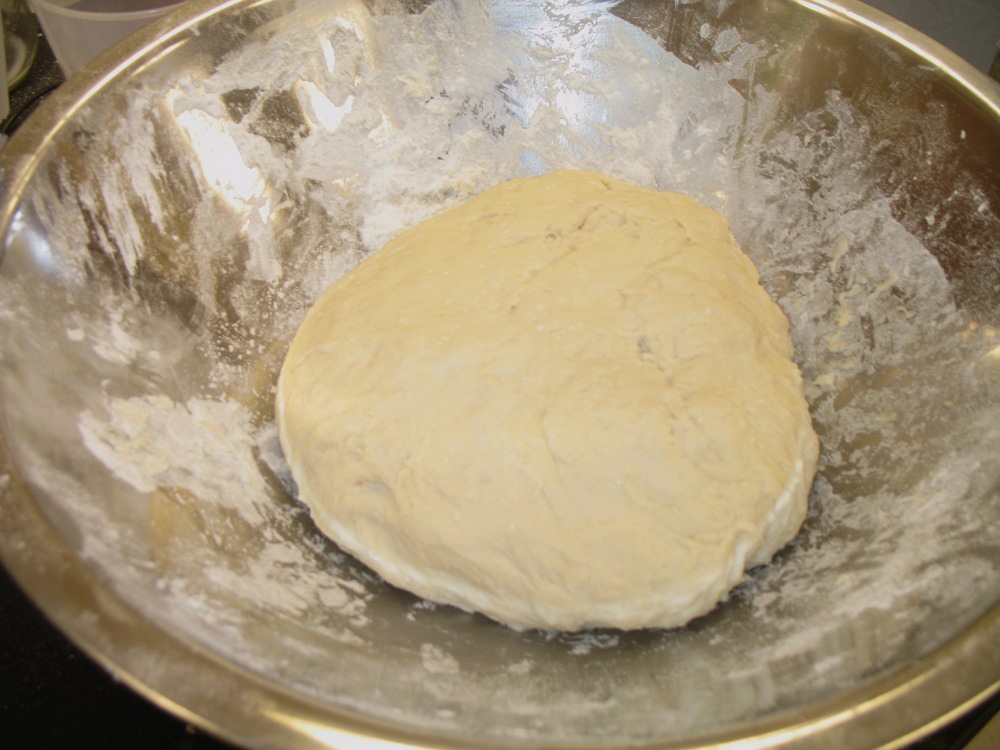
You can tell when the moisture is right, and the dough is ready, when it stops sticking to your fingers.

This dough seems a little too wet. They'll sprinkle a little flour on the top and kneed it in. When the dough is ready, it won't stick to your fingers. The last time I said something about their dough needing a bit of flour, the student told me that they knew very well and I should go away because I was just causing trouble. I consider this a success.
I’ve not had any student who was unable to manage the dough, but the quality of the end result depends on the amount of care and effort the students put into it. Unsurprisingly, the more tactile oriented students tend to produce some magnificent dough.

The kneeding is done, and the dough is ready to rise.
Rising and Baking
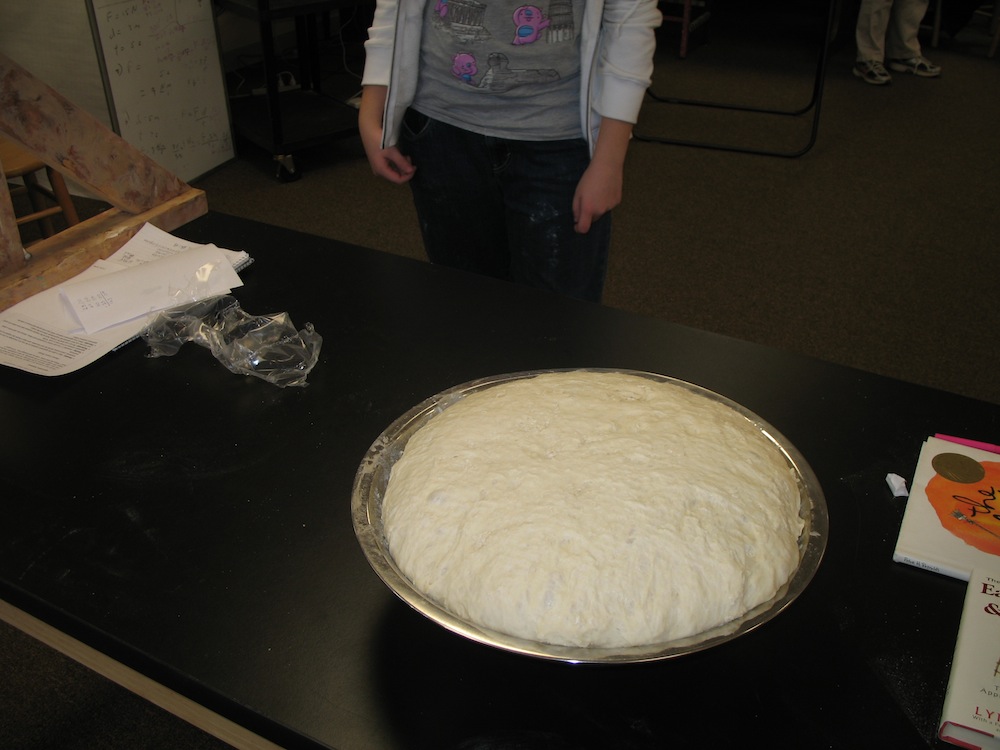
Once you have a nice dough, it needs to rise for about an hour, although we’ve found that 45 minutes works better since we prefer slightly smaller loaves. Drape a damp towel over it to keep it moist. Use a big enough towel, because if you’ve done everything right, and the yeast is happy, the dough should double in size.

If the dough is left too long it will expand to fill the entire bowl and begin to collapse in on itself.
After it’s risen, punch the dough down, split it into two, roll each piece into the shape of a loaf, and place them into loaf pans.
Now let it rise again for another hour, or 45 minutes in our case (don’t forget the damp towel).
After the second rise (in the pans), place the loaves into the oven at 350 degrees Fahrenheit for 45 minutes. It usually takes the ovens about 10 minutes to preheat to the correct temperature.
And then, you’re done. Enjoy.

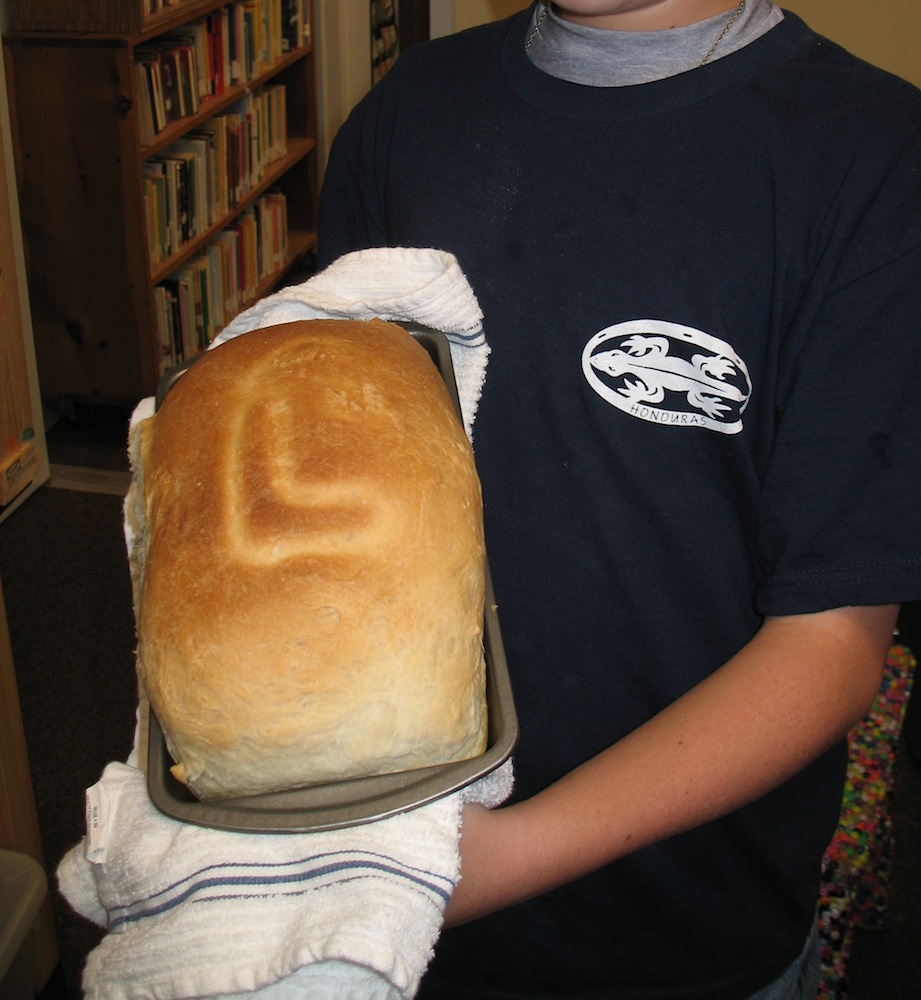
Hot out of the oven, a loaf of bread with the school logo. We set an aluminum foil cutout of the logo on top of the bread while it was baking to imprint the shapes in the crust.
Time
Managed well the entire process can fit nicely into the afternoon schedule. We mixed and kneeded the bread during the half hour of Personal World just after lunch (around 12:30).
With the dry and wet ingredients already measured out ahead of time (once a week during the Student Run Business period) our expert bakers could kneed the dough and clean up after themselves in less than 15 minutes.
Then, all that’s left is to transfer the dough to the bread pans, which takes about 5 minutes (including washing up); put the bread in the ovens an hour later (1 minute); and then taking them out of the oven and washing the big mixing bowl (another 5 minutes). Timed right, the bread is finished just in time for everyone to get to their classroom jobs. It helps that everything, except the mixing bowls, can go into the dishwasher.
Citing this post: Urbano, L., 2011. Bread Baking, Retrieved May 19th, 2012, from Montessori Muddle: http://MontessoriMuddle.org/ .
Attribution (Curator's Code ): Via: ᔥ Montessori Muddle; Hat tip: ↬ Montessori Muddle.
Posted in Natural World, student run businessNo Comments » - Tags: baking bread, bread, cooking, my art photos, overview, recipe
October 28, 2010
We’ve discovered committees. Yesterday, after spending half an hour discussing the brand new bread bag prototype that one of the students came up with, they decided that maybe just the people interested in working on them should work on them. So we just, organically, created a committee.
As with all new discoveries we’re now using them for everything. Today the students decided on a committee to run Dinner and a Show. We’ll see where this goes.
Citing this post: Urbano, L., 2010. Committees, Retrieved May 19th, 2012, from Montessori Muddle: http://MontessoriMuddle.org/ .
Attribution (Curator's Code ): Via: ᔥ Montessori Muddle; Hat tip: ↬ Montessori Muddle.
Posted in Classroom Community, student run businessNo Comments » - Tags: community, student run business
October 1, 2010
Lunch on Wednesdays follows our main block of Student Run Business time. It’s after they’ve delivered pizza, prep-ed for a week of bread, completed finance and its reports, prepared and processed order forms, and sorted out the plants.
Over the last couple weeks I’ve started having my students discuss the business over lunch (including finance reports presentations) and it’s turning into a regular board meeting.
Today they started assigning seating.
We usually sit around two long tables set end to end, with the main supervisor on one end and myself at the other. Today the main supervisor started laying out plates and positions. Pizza supervisor to his right, bread to his right, finances one down from bread and sales across from finances. Everyone else could find their own spot.

I was a little surprised at this unprompted expression of hierarchy. Pizza is our most involved part of the business and the core of the the enterprise so its supervisor, P., has a very important post. She was placed on the right hand of the main supervisor!
I asked the main supervisor why he did it. He said, “I don’t know.” I even had to explain the meaning of the term, ‘right hand “man”‘.
It ended up with the supervisors at one table and everyone else (and myself) at the other.
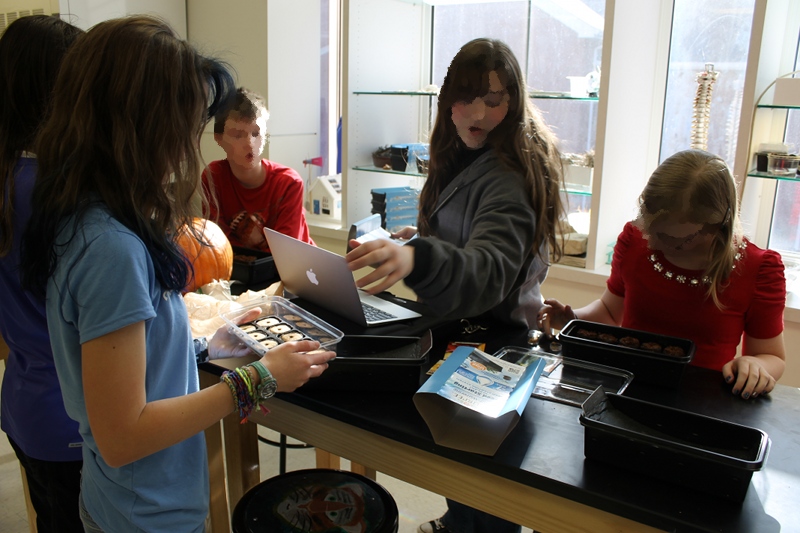
Except for the plants supervisor. Plants have been going slowly, lately, including some seedling failures. The plant supervisor sat all the way down the table, next to me.
…
I can feel it in my bones that there are some interesting lessons in all this. From organizational structure to non-verbal communication.
But since we’re dealing with positions around a table, and we’ve been talking about the importance of place in geography, the best context to discuss this right now might just be one of the importance of geography and place in the interactions among people.
Citing this post: Urbano, L., 2010. Right hand "man", Retrieved May 19th, 2012, from Montessori Muddle: http://MontessoriMuddle.org/ .
Attribution (Curator's Code ): Via: ᔥ Montessori Muddle; Hat tip: ↬ Montessori Muddle.
Posted in Classroom Community, Social World, student run businessNo Comments » - Tags: geography, human nature, my art photos, non-verbal communication, social interactions, SRB
September 19, 2010

Initial oven calibration curves (2009).
Catastrophic failure of one of our ovens! Last year when we started up the bread business, we bought two counter-top ovens within a couple of weeks of each other. They needed to be extra-large to fit two loaves of bread each, which made them a little hard to find. We got a EuroPro oven first, and when we found that it worked pretty well, we went back to try to get another. But just a week later, the store was out of stock and that type of oven could not be found in the city of Memphis or its environs.
Instead we got a GE model. The price was about the same, as was the capacity. We quickly realized that the GE was quite the inferior product. The temperature in the oven was never the same as what was set on the dial. Our bread supervisor at the time ran a calibration experiment, the results of which you can see above, so we still managed to use the oven. Only this year, three weeks into the term, it conked out.
We sold at least one underdone loaf before we realized what had happened, and received a detailed letter in response (which our current bread supervisor handled wonderfully in his own well worded letter). Fortunately, we have found a newer version of our EuroPro oven, which seems to work quite well.
I like the oven calibration exercise. It was a nice application of the scientific process to solve an actual problem we had with the business. Though I know it’s not quite the same, I like the idea of doing annual oven calibrations just to check the health of our equipment and help students realize that the scientific process is a powerful way of looking at the world, not just something you do in science.
Citing this post: Urbano, L., 2010. Oven calibration, Retrieved May 19th, 2012, from Montessori Muddle: http://MontessoriMuddle.org/ .
Attribution (Curator's Code ): Via: ᔥ Montessori Muddle; Hat tip: ↬ Montessori Muddle.
Posted in Natural World, Social World, student run businessNo Comments » - Tags: economics, science, scientific process, student run business
September 18, 2010
Sally, our school’s business manager, was kind enough to come in last month to help the financial department of the student run business organize its books. It was long overdue. We’d been improving our record keeping over the last couple years, but now we have much more detailed records of our income and expenses.
This is great for a number of reasons, the first of which is that students get some good experience working with spreadsheets. We use Excel, which in my opinion is far and away Microsoft’s best product (I’ve been using OpenOffice predominantly for the last year or so because, it improved quite a bit recently, and I’m a glutton for certain kinds of punishment.) I’ve been surprised by how many students get into college unable to do basic tables and charts, but hopefully this is changing.
The second reason is that the Finance committee can now use the data to give regular reports; income, expenses, profit, loss, all on a weekly basis. I expect the Bread division to benefit the most, since it has regular income and expenses, offering students frequent feedback on their progress. We’re now collecting a long-term, time-series data-set that will be very nice when we get to working on statistics in math later on.
In fact, we should be able to use this data to make simple financial projections. Linear projections of how much money we’ll have for our end-of-year trip will tie into algebra quite nicely, and, if we’re feeling ambitious, we can also get into linear regressions and the wave-like properties of the time series of data.
Citing this post: Urbano, L., 2010. Financial reports and statistics, Retrieved May 19th, 2012, from Montessori Muddle: http://MontessoriMuddle.org/ .
Attribution (Curator's Code ): Via: ᔥ Montessori Muddle; Hat tip: ↬ Montessori Muddle.
Posted in Social World, Software, student run business, TechnologyNo Comments » - Tags: economics, excel, finances, Software, student run business