California recently auctioned off a set of carbon emission permits as the start of an effort to reduce emissions of greenhouse gasses with an emissions trading system.
The first 23.1 million permits sold out at $10.09 per ton.
I hope you think that I am an acceptable writer, but when it comes to economics I speak English as a second language: I think in equations and diagrams, then translate.
I sometimes get the question: Why do I have to learn algebra? Followed by the statement: I’m never going to have to use it again. My response is that it’s a bit like learning to read; you can survive in society being illiterate, but it’s not easy. The same goes for algebra, but it’s a little more complex.
Paul Krugman argues for the importance of algebra for anyone thinking about economics, the economy, and what to do about it. Even at the basic level, economists think in mathematical equations and algebraic models, then they have to translate their thoughts into English to communicate them. People who are not familiar with algebra are at a distinct advantage.
There are important ideas … that can be expressed in plain English, and there are plenty of fools doing fancy mathematical models. But there are also important ideas that are crystal clear if you can stand algebra, and very difficult to grasp if you can’t. [my emphasis] International trade in particular happens to be a subject in which a page or two of algebra and diagrams is worth 10 volumes of mere words. That is why it is the particular subfield of economics in which the views of those who understand the subject and those who do not diverge most sharply.
P.S. In the article, he also points out the importance of algebra in the field of evolutionary biology.
Serious evolutionary theorists such as John Maynard Smith or William Hamilton, like serious economists, think largely in terms of mathematical models. Indeed, the introduction to Maynard Smith’s classic tract Evolutionary Genetics flatly declares, “If you can’t stand algebra, stay away from evolutionary biology.” There is a core set of crucial ideas in his subject that, because they involve the interaction of several different factors, can only be clearly understood by someone willing to sit still for a bit of math.
There are some things in this world that we are willing to trade, things that we can put a dollar value on, but there are other things — call them sacred things — values and beliefs that just don’t register on any monetary scale. New research (summarized by Keim, 2012) emphasizes this intuitive understanding, by showing that different part of the brain are used to evaluate these two different types of things.
[W]hen people didn’t sell out their principles, it wasn’t because the price wasn’t right. It just seemed wrong. “There’s one bucket of things that are utilitarian, and another bucket of categorical things,” [neuroscientist Greg Berns] said. “If it’s a sacred value to you, then you can’t even conceive of it in a cost-benefit framework.”
Some of the biggest implications of this work has to do with economics. The traditional, rational view has been that people evaluate everything by comparing the costs versus the benefits. When economists take that rational view of human behavior into other fields, there is a strong sense of overreach (see Freakonomics).
The growing research into behavioral economics, on the other hand, is making a spirited effort grapple with the irrationality of human behavior, much of which probably stems from these two different value systems (sacred vs. cost/benefit). While it’s not exactly the same thing, Dan Ariely‘s books are a good, popular compilation of observations and anecdotes that highlight how people’s irrational behavior extends even into the marketplace.
Planet Money recounts the story of the seminal document that, in 1979, sparked the transformation of China’s economy into capitalism.
A key thing to note: the document was a contract, which assigned property rights to individuals (families actually) rather than the collective. And even though the contract could not be legally binding in communist China, the signers had to be confident enough that it would be respected — by each other at the least.
The result of the change was a 5 fold increase in the amount of food produced by the farm.
Despite the risks, they decided they had to try this experiment — and to write it down as a formal contract, so everyone would be bound to it. By the light of an oil lamp, Yen Hongchang wrote out the contract.
The farmers agreed to divide up the land among the families. Each family agreed to turn over some of what they grew to the government, and to the collective. And, crucially, the farmers agreed that families that grew enough food would get to keep some for themselves.
The contract also recognized the risks the farmers were taking. If any of the farmers were sent to prison or executed, it said, the others in the group would care for their children until age 18.
Marketplace’s Jeff Horwich has an excellent article on the uses of the element phosphorus, where it comes from, why it’s getting scarce, and where we might get more.
The answers to these questions are:
It’s a key element in DNA, so the major use is fertilizer,
most of it comes from Morocco these days,
since Morocco supplies about 85% of the world supply, they’re developing a bit of a monopoly and the price is going up,
the main alternative sources are manure and urine that have lots of phosphorous. In fact, burning sewage leaves behind a phosphorous rich ash.
A key tenant of Montessori is that students have an innate desire to learn, so, as a teacher, you should provide them with the things they need (prepare the environment) and then get out of the way as they discover things themselves.
Upside of Irrationality
In the book, The Upside of Irrationality, Dan Ariely explains from the perspective of an economist how people tend to value things more if they make it for themselves. He uses the example of oragami (and Ikea furniture that you have to assemble yourself), where he finds that people would pay more for something they made themselves, as opposed to the same thing made by someone else.
Just so, students value things more, and remember them better, if they discover them themselves.
“Malthusian” is often used as a derogatory term to refer to alarmist predictions that we’re going to run out of some natural resource. I’m afraid I’ve used the term this way myself, however, according to Lauren Landsburg at the Concise Encyclopedia of Economics, Malthus is being unfairly maligned. He wasn’t actually predicting catastrophe but wondering why the catastrophes don’t usually happen.
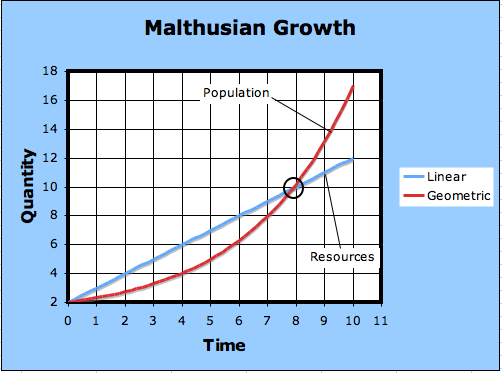
What Thomas Malthus did, in 1798, was point out that while populations grow at a geometric rate – the U.S. population, he noticed, doubled every 25 years – but resources, like food, only increase at an arithmetic rate. As a result, any naturally growing population will eventually run out of resources.
The red line shows geometric growth. No matter how much you start off with, the red line will always end up crossing the blue line.
The linear equation has the form:
where y is the quantity produced, t is time (the independent variable), and m and b are constants. This should not look to unfamiliar to students who’ve had algebra.
The geometric equation is a little more complicated:
here a, g and c are constants. g is the most important, because it’s the growth rate – the higher g is the faster the curve will rise. You can play around with the coefficients and graph in this Excel spreadsheet .
At any rate, after the curves intersect, the needs of the population exceeds how much it can produce; this is the point of Malthusian catastrophe.
The intersection point is where the needs of the population exceeds the production.
The observation is, indeed, so stark that it is still easy to lose sight of Malthus’s actual conclusion: that because humans have not all starved, economic choices must be at work, and it is the job of an economist to study those choices.
— Landsburg (2008): Thomas Robert Malthus from The Concise Encyclopedia of Economics.