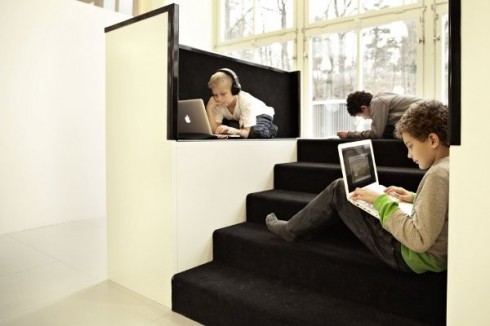
When given the choice, the environments students choose to work in does not look like the typical classroom. Mrs. D., our head of school, shared a link to this article about the Swedish Telefonplan School that’s designed with the students’ preferences in mind.
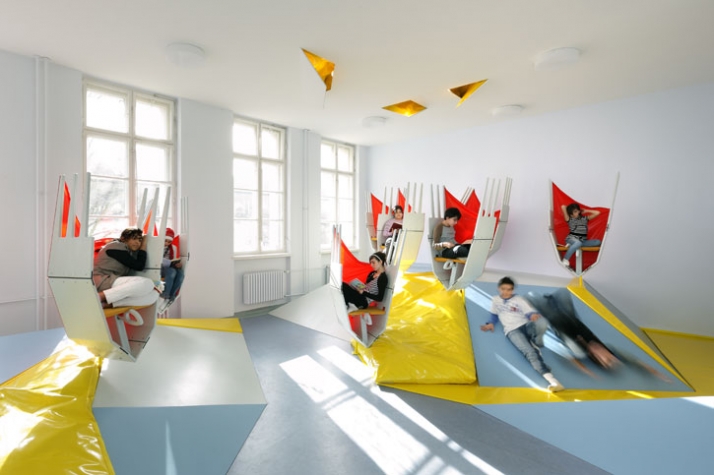
From inside the Telefonplan School. Image via Zilla Magazine (hat tip Edudemic).The inside of the Erika-Mann Elementary School. Photo by Jan Bitter.
It’s a lot like the Erika-Mann-Grundschule in Berlin, and the type of open-plan rooms that Montessori Middle Schools aim for. I particularly note the design gives lots of space for small group work. Adolescents tend to cluster, but seem to work most productively in smaller groups.
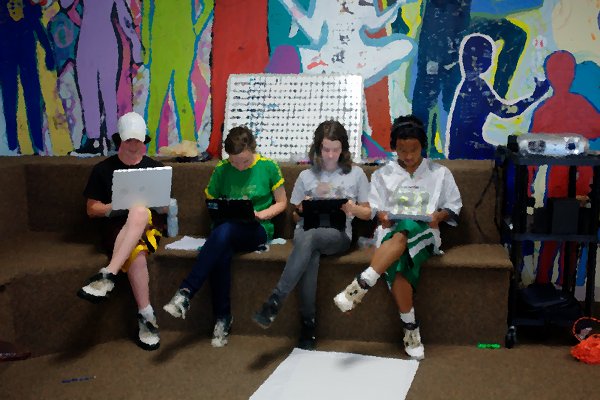
The group of Lamplighter Montessori students work in parallel but help each other out.
And given the choice, students often prefer the floor to the tables.
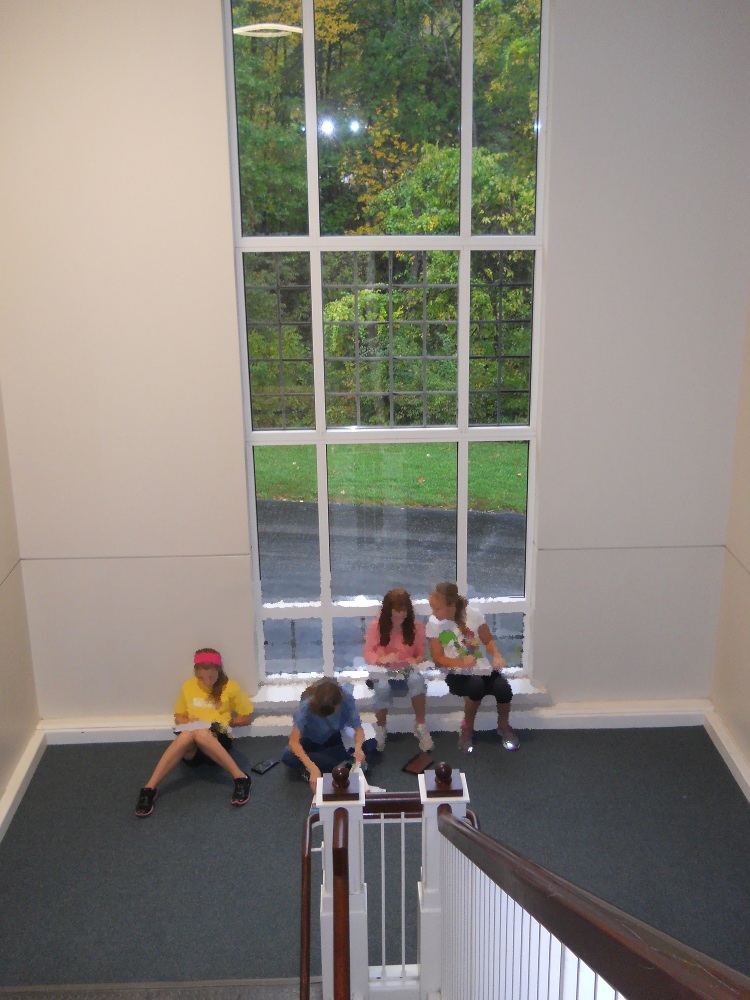
Fulton School students choose to sit in the window to work on their math.
Ian Simpson has an interesting article on the movement to reduce the numbers of the invasive snakehead fish more appealing to restaurants and their customers.
[Snakeheads have] dense, meaty, white flesh with a mild taste that is ideal for anything from grilling to sauteing.
…
[But] the fish are air breathers that can last for days out of water. Even when gutted and with their throats cut, they gape for breath, said John Rorapaugh, director of sustainability and sales at ProFish, a Washington wholesaler.
“Once they get to mature size, they are on top of the food chain and are ravenous,” he said.
…
Josh Newhard, an expert on the snakehead with the U.S. Fish and Wildlife Service, said it was too early to say what the snakehead’s long-term impact would be on its invaded environment. … “The potential is really high for them to impact other fish species. The fact that people want to remove them from the system is really good,” he said.
My middle-school students are reading Janet Kagan’s short story, “The Loch Moose Monster” as part of our discussion about genetics, ecology and educational environments. This article makes a nice complement.
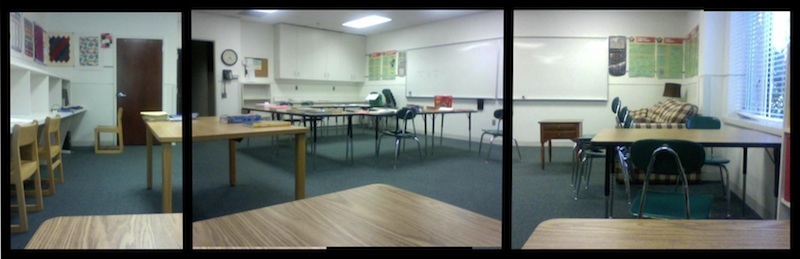
I’m setting up a new classroom this year. How it’s arranged is very important to me. Montessori classrooms are designed for open movement and having different things going on in different places at the same time. Unlike last year, I won’t have to manage the entire middle school in the same room for the entire day. Instead, middle and high-school students will come in for two-hour periods for math and science.
Two hours is a long time for anyone, so I don’t expect them to be able to sit still for the entire period. In fact, just like in last year’s middle school classroom, I intend that the class devolve into smaller groups for most of that time. Students will need to be able to move around freely and associate freely, so long as they respect each others ability to work. I’m trying to arrange the room to facilitate that.
So how to arrange the furniture?
I need open spaces for students to walk and move. Eric Jensen has an entire chapter of Teaching with the Brain in Mind dedicated to how important movement is to learning. His focus is primarily on the need to save time for recesses and PE in increasingly regimented school days, but he also talks about integrating movement into everyday learning: energizers to wake kids up; stretching for more oxygen; and so on. I certainly know that I do a lot of pacing when I’m trying to think.
David Walsh also sees movement in the classroom as particularly important for boys.
Adolescent boys can have five to seven surges of testosterone every day. … And because testosterone is geared towards quick release, adolescent boys are prone to follow any impulse that might release stress. [p. 62]
…
Some experts think that making students sit still at a desk all day isn’t good for either sex, but girls are better able to tolerate it. Boys are more likely to get frustrated by school and loose interest. [p. 100]
So no rows of desks. Instead, I’ve tried to make different work areas.
There’s one big area with a set of tables along three sides of a rectangle facing the whiteboard; students can be inside or outside of the rectangle depending on their needs.
Another area is centered around the couch, which may seem highly desirable, but I’ll be curious to see how they use it to work.
Toward the back of the room, there’s a solitary, larger-than-normal desk for a larger group that need space from the big set of tables.
I also have a smaller table near the window, that I envision would appeal to smaller, quieter groups, or even individuals sharing the same table.
And, finally, there is a bank of individual work spaces along the back wall.
That’s the plan, anyway. Classes have not started yet, so we’ll see how it holds up when it meets the enemy students. I am always happy to let them rearrange things, but most often they don’t seem to want to spend the time and effort.
Molly Backes, an author of young adult fiction, considers the question from a mother about her teenager, “She wants to be a writer. What should we be doing?”
Her first answer was, “You really do have to write a lot. I mean, that’s mostly it. You write a lot.”
But then she thought about it, and that’s where it gets really interesting:
First of all, let her be bored. …
Let her be lonely. Let her believe that no one in the world truly understands her. …
Let her have secrets. …
…
Let her fail. Let her write pages and pages of painful poetry and terrible prose. …
Let her make mistakes.
…
Let her find her own voice, even if she has to try on the voices of a hundred others first to do so. …
Keep her safe but not too safe, comfortable but not too comfortable, happy but not too happy.
At the end she posts a picture of her collection of forty-two writer’s notebooks.
It’s a wonderfully written and well considered post that I’d recommend to anyone trying to teach writing and language, particularly if you take the apprentice writer approach. And, I’ve always been a great believer in the power of boredom.
Backes’ advice more-or-less summarizes my interpretation of the Montessori approach: create a safe environment and give students the opportunity to explore and learn, even if it means a certain amount of struggle and failure.
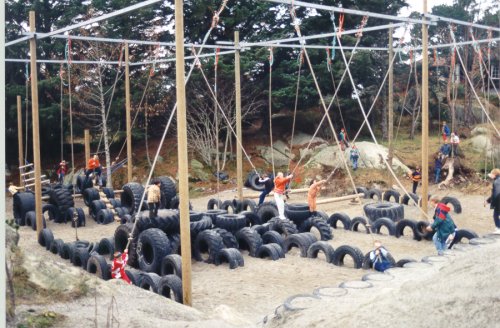
Jungle play area at the Skudeneshavn Primary School in Karmøy on the west coast of Norway is another great example of creating an environment that offers students the opportunity to explore.
It’s also interesting to note how differently writers and other experts think, yet how much their practices overlap. Mathematician Kevin Houston also recommends writing a lot when he explains how to think like a mathematician, but his objective is to use full, rigorous sentences to clarify hard logic, and less to explore the beauty of the language or discover something profound about shared humanity.
[…] the whole idea of revenge and punishment is a childish daydream. Properly speaking, there is no such thing as revenge. Revenge is an act which you want to commit when you are powerless and because you are powerless: as soon as the sense of impotence is removed, the desire evaporates also.
Who would not have jumped for joy, in 1940, at the thought of seeing S.S. officers kicked and humiliated? But when the thing becomes possible, it is merely pathetic and disgusting.
Over the last couple of weeks, students have been reading and presenting newspaper articles every morning, so, inevitability, we had a few good opportunities to discuss the death of Osama bin Laden.
The discussions were remarkably mature, and quite edifying to hear, because it was pretty much what one would hope to occur among Montessori kids who’ve been dealing with the peace curriculum since pre-school.
There was remarkably little jubilation. So much so, that one student asked, “Are we not supposed to feel happy?”
The answer was that yes we can feel happy and relieved but we shouldn’t “spike the ball”, letting the celebration get so out of hand that it antagonizes bin Laden’s supporters even more, and makes us seem as arrogant as they caricature us to be. If we want to achieve peace we need to be better than that.
Their broader perspective is somewhat akin to what Thich Nhat Hanh, a Zen monk, expressed a couple weeks after the September 11th attack (thanks to Julie H. for the link to the interview by Anne A. Simkinson).
All violence is injustice. The fire of hatred and violence cannot be extinguished by adding more hatred and violence to the fire. The only antidote to violence is compassion. And what is compassion made of? It is made of understanding. When there is no understanding, how can we feel compassion, how can we begin to relieve the great suffering that is there? So understanding is the very real foundation upon which we build our compassion.
[…]
There are people who want one thing only: revenge. In the Buddhist scriptures, the Buddha said that by using hatred to answer hatred, there will only be an escalation of hatred. But if we use compassion to embrace those who have harmed us, it will greatly diffuse the bomb in our hearts and in theirs.
There’s also a poignant reflection by Megan McArdle, a New Yorker, who was, at first, extremely angry and eager for revenge, but has become much more reflective, and cognizant that we share both humanity and mortality with even Osama bin Laden.
The BBC has a fascinating article on the Finnish educational system; specifically, why it consistently ranks among the best in the world despite the lack of standardized testing. A couple things stand out to me as a Montessori educator.
The first is the use of peer-teaching. There’s a broad mix of abilities in each class, and more talented students in a particular subject area help teach the ones having more difficulty. It’s something I’ve found to be powerful tool. The advanced students improve their own learning by having to teach — it’s axiomatic that you never learn anything really well until you have to teach it to someone else. The struggling students benefit, in turn, from the opportunity to get explanations from peers using a much more familiar figurative language than a teacher, which can make a great difference. I give what I think are great math lessons and individual instruction, but when students have trouble they go first to one of their peers who has a reputation for excelling at math. In addition to the aforementioned advantages, this also frees me up to work on other things.
A second thing that stands out from the BBC article is how the immense flexibility the teachers have in designing their teaching around the basic curriculum coincides with a very progressive curriculum. This seems an intimate consequence of the lack of assessment tests; teachers don’t have to focus on teaching to the test and don’t face the same moral dilemmas. Also, this allows teachers to apply their individual strengths much more in the classroom, making them more interested and excited about what they’re teaching.
E.D. Kain has an excellent post on the video The Finland Phenomenon that deals with the issue specifically. It’s full of frustration at the false choices offered by the test-driven U.S. system.
PsyBlog has an excellent summary of the research on social loafing, the phenomena where people working in a group work less compared to when they work alone. Because we do so much group work, this is sometimes an issue.
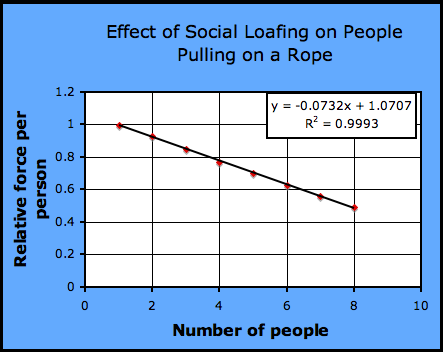
The first research on social loafing came from Max Ringelmann way back in 1913 (Ringelmann, 1913). He had people pulling on a rope, and compared the maximum they could have pulled, based on individual test, to how much each person actually pulled. The results were, kind of, sad; with eight people, each one only pulled half as much as their maximum potential strength. A graph of Ringelmann’s data is shown below. If everyone pulled at their maximum the line would have stayed horizontal at 1.
The relative loafing of people working in a group. As the group gets larger, the amount of work per person decreases from its maximum of 1. Data from Ringelmann (1913)
The PsyBlog article points out three reasons why people tend to loaf in groups:
We expect others to loaf so we do it, too.
We feel more anonymous the larger the group, so we feel less need to put in the effort.
We often don’t have a clear idea about how much we need to contribute, so we don’t put in as much as we could.
This can be summed up in Latane’s Social Theory:
If a person is the target of social forces, increasing the number of other persons diminishes the relative social pressure on each person.
The key is making sure students are motivated to do the work. We want self-motivated students, but creating the right environment, especially by training students in how to work in a group will help.
Make sure students realize the importance of their work; this makes them more motivated.
Build group cohesion; team members contribute more if they value the group they’re in.
Make sure the group clearly and fairly divides the work. Let everyone be part of the decision making process so students have choices in what to do will help them be more invested in their part of the work.
Make sure each group member feels accountable for their share of the work.
A Brief Excursion into Mathematics
Ringelmann’s data falls on a remarkably straight line, so I used Excel to plot a trendline. As my algebra students know, you only need two points to write the equation of a line, however, Excel uses linear regression to get the best-fit line through all the data. Not all the data points will be on the line (sometimes none of them will be on the line) but the sum of the distance from each point to the line is minimized.
Curiously, since the data is pretty close to a straight line, you can extend the line to the x-axis to find out how many people it would take for no-one to be exerting any force at all. Students should be able to determine the equation of the line on their own, but you can get Excel to give you the equation of the trendline. From the plot we see:
y = -0.0732 x + 1.0707
At the x-axis, y = 0, so;
0 = -0.0732 x + 1.0707
solving for x we first subtract the constant, 1.0707 from both sides to get:
0 – 1.0707 = -0.0732 x + 1.0707 – 1.0707
giving:
-1.0707 = -0.0732 x
then divide by -0.0732 to isolate x:
which yields:
x = 14.63
This means that with 15 people, no-one will be pulling on the rope. In fact, according to this equation, they’ll actually start pushing on the rope.
It’s an amazing result, but if you can find flaws with my argument or math, please let me know.
Frederic Hess’ new book advocates a diversity in educational formats. Steven Teles has a detailed review.
The Same Thing Over and Over: How School Reformers Get Stuck in Yesterday's Ideas by Frederic Hess.
Hess shares the same basic premise of most progressive, constructivist, educational approaches like Montessori’s, that students learn differently so they need different educational approaches. However, he takes this need for diverse educational environments further with the recognition that teachers are different so they will have their own educational philosophies and methods that work best for them, and that parents are different, with very different expectations about what education should be and what it should accomplish.
… the basic components of schooling—parents, children, school leaders, and teachers—are irreducibly diverse. Parents have different ideas about what a “well-educated” child is, and children differ quite significantly in temperament, aptitude, habits, and interests. School leaders vary as to how they think schools should be run, while teachers have different skill levels, enthusiasm for different tasks, and ideas about what children should learn and know.
… Educators will always be less effective if they are made to teach in a way that they believe is wrongheaded or that they haven’t bought into. Students will have difficulty learning if they are forced to work at a pace that is too fast or too slow, or if they are taught in a manner that doesn’t match their individual learning styles. Parents can be disengaged or hostile if the pedagogy, discipline, or school culture differ fundamentally from what they think is right for their child. And schools as a whole will be incoherent and disorganized if they cannot count on some baseline of agreement as to what—and who—the school is for.
Although Hess works for the conservative American Enterprise Institute his own thought on education are far from traditional:
[T]here is value in nurturing diverse intellectual traditions, models of thought, bodies of knowledge, and modes of learning. It is prudent to embrace a system of schooling that nurtures a diverse set of skills, knowledge, and habits of mind. This allows us to foster intellectual diversity that enriches civil society and … [i]t allows individual schools, educators, and providers to excel at something, rather than asking every school to excel at everything.
Furthermore, Hess argues, the world has changed since the inception of universal education, but the educational system has not adapted to the changing needs and technology. He points out new innovations allowed by technology, like the School of One program in New York.
All of this is hard to argue with. It’s almost the standard constructivist critique of the current educational system, although constructivists tend to focus on how we’ve not applied all the stuff we’ve learned about pedagogy since the 19th century (Lillard, 2005 lays out this argument eloquently in Montessori: The Science Behind the Genius).
Hopefully, this book broadens and advances the arguments for reforming the educational system. It is a progressive view from a conservative organization. Yet it still begs the question of how do we get there from here, while dealing the serious concerns that greater diversity may well lead to some failures as well as successes. Ultimately, we end up with the same fairly intractable problem. However, how do you measure success where there is such a diversity of expectations for education?