Tyler Vigen has a great website Spurious Correlations that shows graphs of exactly that.
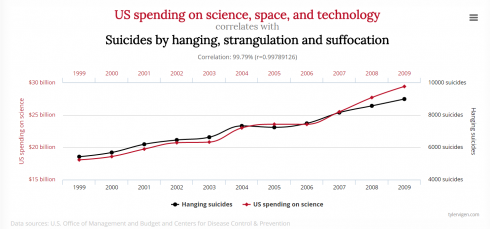
Great for explaining what correlation means, and why correlation does not necessarily mean causation.
Middle and High School … from a Montessori Point of View
Tyler Vigen has a great website Spurious Correlations that shows graphs of exactly that.
Great for explaining what correlation means, and why correlation does not necessarily mean causation.
For talking about migration, here’s a short video showing one day’s worth of air traffic around the world from the Zurich School of Applied Sciences. It’s pretty amazing.
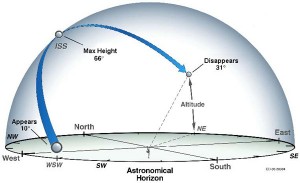
NASA’s Spot the Station website tells you when and where to look to see the space station.
The lucky try more things, and fail more often, but when they fail they shrug it off and try something else. Occasionally, things work out.
— McRaney, 2013: Survivorship Bias on You Are Not So Smart.
David McRaney synthesizes work on luck in an article on survivorship bias.
… the people who considered themselves lucky, and who then did actually demonstrate luck was on their side over the course of a decade, tended to place themselves into situations where anything could happen more often and thus exposed themselves to more random chance than did unlucky people.
Unlucky people are narrowly focused, [Wiseman] observed. They crave security and tend to be more anxious, and instead of wading into the sea of random chance open to what may come, they remain fixated on controlling the situation, on seeking a specific goal. As a result, they miss out on the thousands of opportunities that may float by. Lucky people tend to constantly change routines and seek out new experiences.
McRaney goes also points out how this survivorship bias negatively affects scientific publications (scientists tend to get successful studies published but not ones that show how things don’t work), and in war (deciding where to armor airplanes).
Ambient noise from inside the space station.
See also the sound of rocks banging on your spacecraft.
Jonni Good’s Paper Mache Clay recipe is useful classroom construction material that’s pretty cheap and easy to make.
More details at Ultimate Paper Mache.
Berndnaut Smilde generates and photographs clouds inside buildings, “He uses a fog machine and carefully adjusts the temperature and humidity to produce clouds just long enough to photograph.”
William Sieghart does a wonderful question and answer in his Poetry Pharmacy in the Guardian, where he recommends poetry to salve his questioners existential (and not so existential) needs.
For example:
Hi William,
Do you have any poems that clear up a hangover or diarrhoea (preferably both)?
Sounds like you have been living life to the full! Why not congratulate yourself on the good times you enjoyed yesterday rather than being miserable about your today’s predicament? Dryden’s Happy the Man is a good bet:
Not Heaven itself upon the past has power,
But what has been, has been, and I have had my hour.
Another:
It’s a restriction insisted upon by my tenancy – I’m not allowed to keep a dog. I need a poem to help fill the gap left by the absence of a faithful hirsute canine companion. Dr Sieghart, what do you suggest?
Dr Sieghart’s remedy:
I prescribe some of the most famous words in English – ‘You’ll Never Walk Alone’ by Oscar Hammerstein II. The great consoling line of the title comes after the pain of isolation:Walk on, through the wind
Walk on, through the rain
Though your dreams be tossed and blownWalk on, walk on, with hope in your heart
And you’ll never walk alone
You’ll never walk alone.